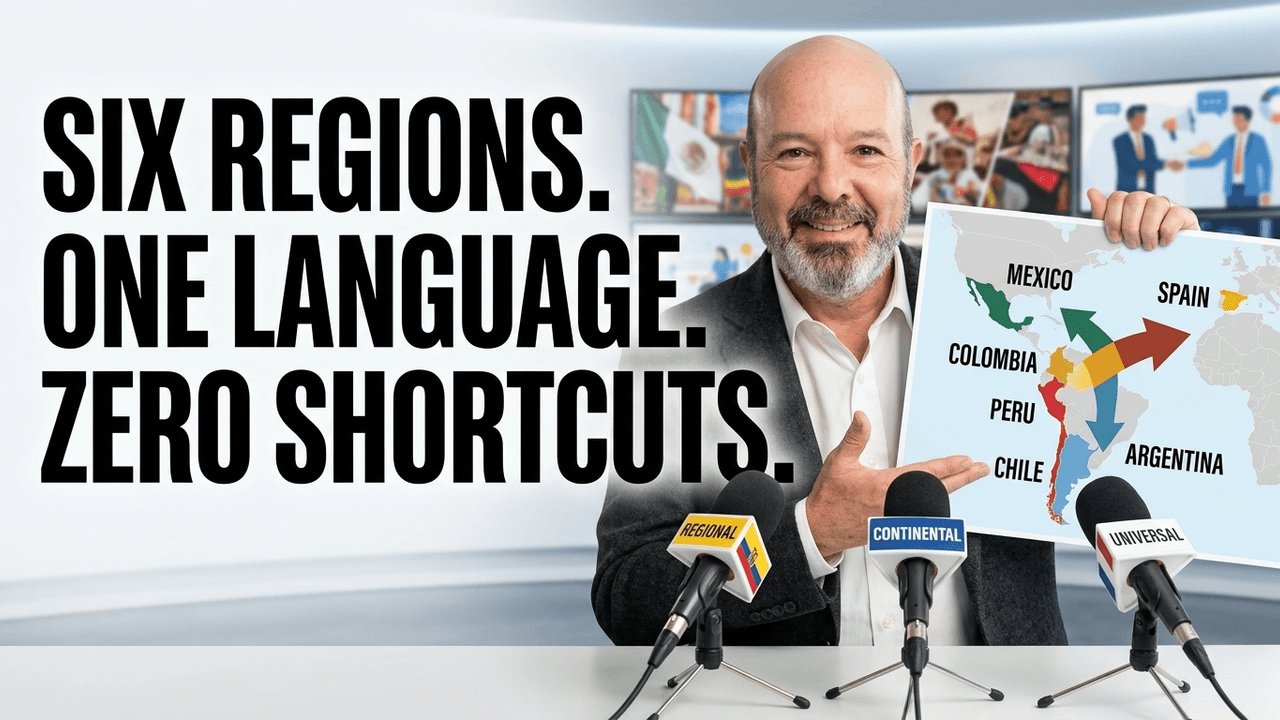
Spanish is not one language. Across Latin America and Spain, the same words carry different weight, the same tone lands differently, and the same campaign can succeed in one market while quietly failing in another. This guide maps the regional differences that actually matter for business.
This is not an academic exercise. It is a practical reference for anyone making decisions about Spanish-language content, customer communications, or market entry strategy. The goal is not to memorize every regional nuance — it is to understand which differences are commercially significant and how to act on them.
Why Regional Spanish Matters for Business
Most companies entering Latin America treat Spanish as a single language. They produce one version of their content and deploy it across Mexico, Colombia, Argentina, Chile, and the US Hispanic market simultaneously.
The result is content that reads correctly everywhere and connects deeply nowhere. It feels like a broadcast — technically accurate, regionally anonymous, and slightly distant in every market it touches.
The companies that get localization right do something different. They understand that Spanish-speaking customers are not a monolithic audience. They are Mexicans, Colombians, Argentines, Chileans — each with distinct cultural identities, communication norms, and expectations of the brands that want their business.
The Three Types of Spanish — A Quick Map
Before diving into the regions, it helps to understand the three functional types of Spanish that businesses use:
- Universal Spanish — Neutral, region-free. Correct everywhere, local nowhere. Best for backend software, legal templates, and internal documentation that needs to work across multiple markets.
- Continental Spanish — Appropriate across Latin America and the US Hispanic market but not Spain. Works for regional campaigns that don't need per-country precision. A good starting point for brands entering multiple markets simultaneously.
- Regionalized Spanish — Fully adapted to a specific country or sub-region. Required for anything customer-facing: marketing, sales copy, support scripts, onboarding, HR materials. This is the version that actually converts.
A practical rule: if your content needs to move someone — to buy, to trust, to stay — it needs Regionalized Spanish. Everything else can use Universal or Continental as a starting point.
Mexico and Central America
Mexico is the largest Spanish-speaking market and the most common entry point for US companies expanding into Latin America. It is also one of the most distinct linguistically and culturally.
Tone: Warm, indirect, and relationship-oriented. Mexican business communication values courtesy and personal connection. Blunt directness — which works well in some other markets — can read as rude or cold here.
Formality: The usted/tú distinction matters significantly in B2B and formal communications. Defaulting to tú too early signals a lack of respect. Most customer-facing content should begin with usted and adjust based on the relationship.
Vocabulary: Mexican Spanish has a rich vocabulary of localisms — words and expressions that are standard in Mexico but meaningless or odd elsewhere. Chido (cool), chamba (work/job), ahorita (a uniquely flexible concept of time) — these are touchstones that signal genuine local knowledge when used correctly.
Key watch-out: Central American markets (Guatemala, El Salvador, Honduras, Costa Rica) share proximity to Mexico but have distinct identities and should not be treated as interchangeable with Mexican Spanish.
Colombia and the Andes Region
Colombia is increasingly the preferred entry point for tech companies, fintechs, and professional services firms entering Latin America. Bogotá in particular has developed a reputation for having the clearest, most "neutral" Spanish accent on the continent — which makes Colombian content relatively accessible across markets.
Tone: Professional, formal, and warm. Colombian business culture places high value on education, professionalism, and respect. Content that signals expertise and care lands well.
Formality: Usted is used more broadly in Colombia than in most other markets — including between friends in some regions. Defaulting to usted in professional communications is almost always the right call.
The broader Andes region (Ecuador, Peru, Bolivia) shares many characteristics with Colombian Spanish but has distinct local vocabularies and cultural references. Peru in particular has a growing middle class and digital economy that rewards locally-aware communication.
Key watch-out: Do not assume Colombian Spanish works equally well across the Andes. A Peruvian customer will notice content calibrated for Bogotá.
Argentina and the Southern Cone
Argentina is perhaps the most linguistically distinct Spanish-speaking market in Latin America — and the one that most frequently trips up companies that think their Mexican or Colombian localization will travel.
Voseo: Argentina, Uruguay, and parts of Paraguay use vos instead of tú as the second-person singular pronoun. This changes verb conjugations throughout — vos tenés instead of tú tienes, vos sos instead of tú eres. Content localized for Mexico that uses tú forms immediately signals that it was not made for an Argentine audience.
Tone: More direct and less deferential than Mexico or Colombia. Argentines tend to value intellectual confidence and wit. Overly formal or corporate-sounding content can feel stiff and distant.
Chile: Chilean Spanish is fast-paced, heavily slanged, and genuinely difficult for non-Chileans to follow at full speed. For business communications, a more neutral register is generally recommended — but the vocabulary and cultural references should still be specifically Chilean.
"Content localized for Mexico that uses tú forms immediately signals to an Argentine audience that it was not made for them. They will feel it before they can articulate it."
The Caribbean Region
Puerto Rico, Cuba, and the Dominican Republic share a Caribbean Spanish that is phonetically distinct (final consonants are often dropped or softened) and culturally vibrant. For US-based companies, Puerto Rico is particularly significant — it is a US territory with a Spanish-dominant culture and a large diaspora in major US cities.
Tone: Warm, expressive, and fast-paced. Caribbean Spanish tends toward informality and directness. Content that feels overly corporate or stiff will underperform here.
Key watch-out: The East Coast US Hispanic market is heavily Caribbean-influenced. If your target audience is US Hispanic consumers in New York, Miami, or Boston, Caribbean Spanish norms are more relevant than Mexican Spanish norms — even if your company is US-based.
US Hispanic Markets
The US Hispanic market is not a single audience. It divides primarily along two axes:
- Southwest (California, Texas, Arizona): Mexican-dominant heritage, with strong ties to Mexican Spanish vocabulary and cultural references.
- East Coast (New York, Miami, New Jersey): Caribbean-dominant heritage, particularly Puerto Rican and Dominican in New York, Cuban in Miami.
Second and third-generation US Hispanic consumers often have a relationship with Spanish that is more identity-based than functional. Content that signals genuine cultural respect — not just linguistic correctness — performs significantly better with this audience than content that is simply translated into Spanish.
Spanglish and code-switching are natural and common in everyday communication. Brands that engage with this authentically (when appropriate to their category) build stronger connections than those who insist on formal Spanish.
Spain
Spain is included here for completeness, but it is worth noting that most Latin American expansion strategies do not need to account for Spain — the markets are distinct enough that separate strategies are warranted.
Vosotros: Spain uses vosotros as the second-person plural, which does not exist in Latin American Spanish. Content written for a Spanish (Spain) audience sounds immediately foreign in Latin America.
Tone and vocabulary: Peninsular Spanish has distinct vocabulary, expressions, and a generally more direct tone than most Latin American markets. Content written for Spain should not be deployed in Latin America, and vice versa.
The Practical Takeaway
You do not need to become an expert in every regional variant of Spanish. You need to know three things:
- Which market you are actually targeting — not "Latin America" but a specific country or sub-region
- Which type of Spanish applies to each content category (Universal for internal docs, Regionalized for anything customer-facing)
- Where to get help from a specialist who knows that specific market from the inside
The companies that do this well do not have larger budgets. They have better information — and they act on it before launch rather than after.
Not sure which Spanish your content needs?
Book a call — we'll map it out together in 30 minutes