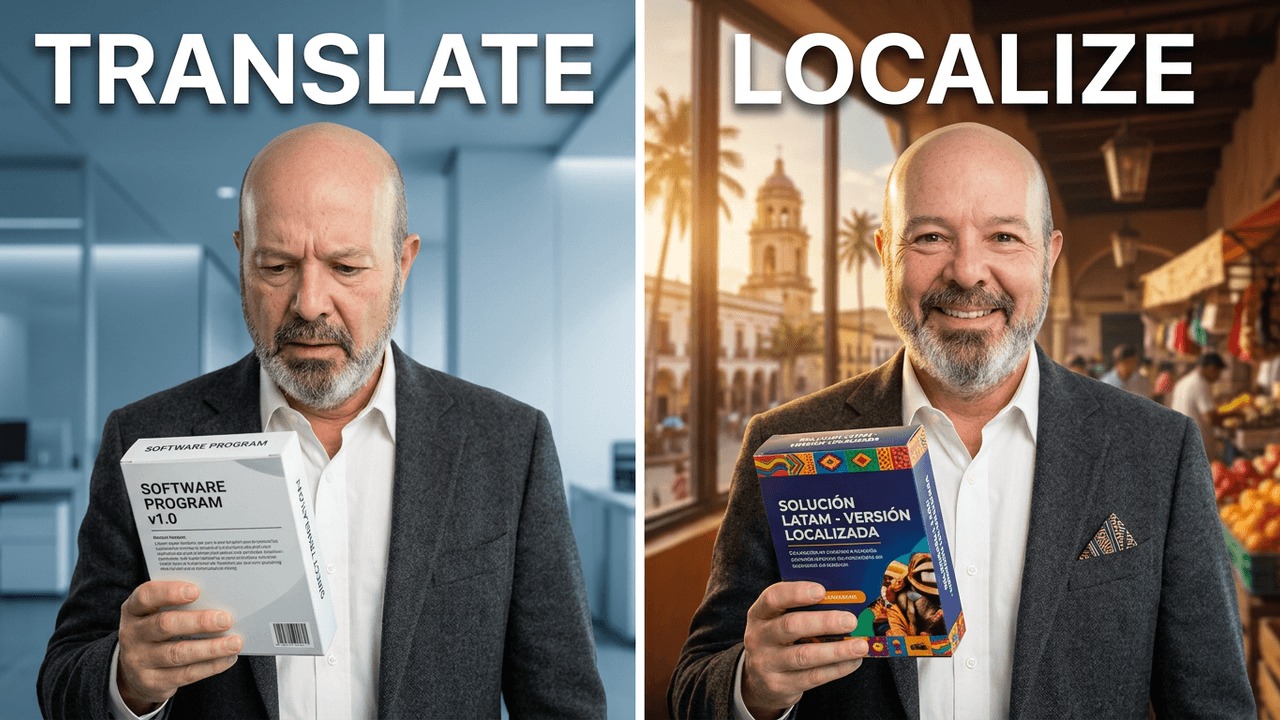
Most companies think they have the language handled. The website is in Spanish. The marketing is translated. The team has done the work. But the message still feels imported, and that quiet friction is what kills conversion.
Translation and localization are not the same thing. Understanding the difference, and knowing when each one applies, is one of the most commercially important decisions a company expanding into Latin America can make.
What Translation Actually Does
Translation converts words from one language to another. Done well, it produces content that is grammatically correct, accurately conveys the original meaning, and can be understood by a native speaker of the target language.
That is genuinely useful. For legal documents, technical specifications, and internal communications that need to be understood across language barriers, accurate translation is exactly what you need.
But it has a ceiling. And that ceiling shows up the moment your content needs to do more than be understood, the moment it needs to connect, persuade, or convert.
What Localization Actually Does
Localization starts from the same place as translation — the original text, but asks a different question. Instead of "how do I say this in Spanish," it asks "how would a person from this specific market naturally express this idea, to this specific audience, in this specific context?"
That question changes everything. The vocabulary shifts. The tone adjusts. The examples and references become locally recognizable. The emotional register, the warmth, the directness, the formality level, aligns with what the audience actually responds to.
Customers cannot always articulate why localized content feels different. They just feel it. And they act on it.
The Gap Between Them — In Real Numbers
One e-commerce company we worked with launched in Mexico with a translated version of their US website. Traffic was strong. Conversion was not. Checkout abandonment was running at 68 percent and the team could not identify why.
We ran a regional localization audit, product descriptions, UI copy, promotional content, and the checkout flow. European Spanish phrasing was replaced with Mexican regional expressions. The promotional calendar was realigned to local events rather than US retail dates. The checkout copy was rewritten to match the warmth and directness that Mexican customers expect.
"Conversion on the localized pages increased by 31 percent in the first quarter. The product did not change. The message did."
That is not an exceptional result. It is a typical one when a company moves from translation to proper localization for the first time.
Spanish Spans More Than 20 Countries
One of the most common misconceptions we encounter is treating Spanish as a single language. It is not. Spanish spans more than 20 countries, each with its own tone, vocabulary, humor, and emotional cues.
- Mexican Spanish is not Argentine Spanish
- Colombian Spanish is not Chilean Spanish
- US Hispanic Spanish on the East Coast is not the same as in the Southwest
A single translated version applied across all of them produces content that feels generic at best and off-putting at worst. Generic does not build loyalty. Generic does not convert.
When to Use Each One
Translation is appropriate for content where correctness is the goal — legal documents, compliance materials, technical documentation, internal communications. Precision matters more than resonance.
Localization is appropriate for any content where you need the audience to respond — marketing, sales copy, onboarding, support scripts, product descriptions, HR materials, and anything customer-facing. Resonance matters more than literal accuracy.
The practical test: if your content needs to move someone — to buy, to trust, to stay, to act — it needs localization. If it just needs to inform, translation may be sufficient.
The AI Translation Question
Modern AI translation tools are genuinely impressive at producing grammatically correct output quickly. They are considerably less impressive at tone, cultural nuance, regional vocabulary, and emotional register.
Even the most advanced AI translation tools currently require up to 80 percent of their output to be edited by a human expert before it is business-ready. That is not a criticism of the tools — it is simply an accurate description of what they do and do not do well.
We use AI tools where they add speed without sacrificing quality. And we build the human expert review into every project as standard — not an optional add-on.
Not sure if your Spanish content is hitting the right tone?
DM us SPANISH CHECK — We'll review your materials freeWhat to Do Next
If you have existing Spanish content — a website, marketing materials, onboarding flows, or support scripts — the first step is an honest assessment of whether it was translated or localized, and for which specific market.
If it was translated by a generalist agency or a machine, there is almost certainly a localization gap. The question is where it is and how much it is costing you.
That is exactly what our free localization review covers. We look at your existing content, identify the specific gaps, and give you a clear picture of what needs to change and why.